Shōdan in Okina
Okina-no-mai
The dance is divided into three parts, each articulated by a cadential sequence of three stamps—Heaven, Earth, and Man—reflecting the Eastern concept of a trinity that symbolizes the completeness of the universe.
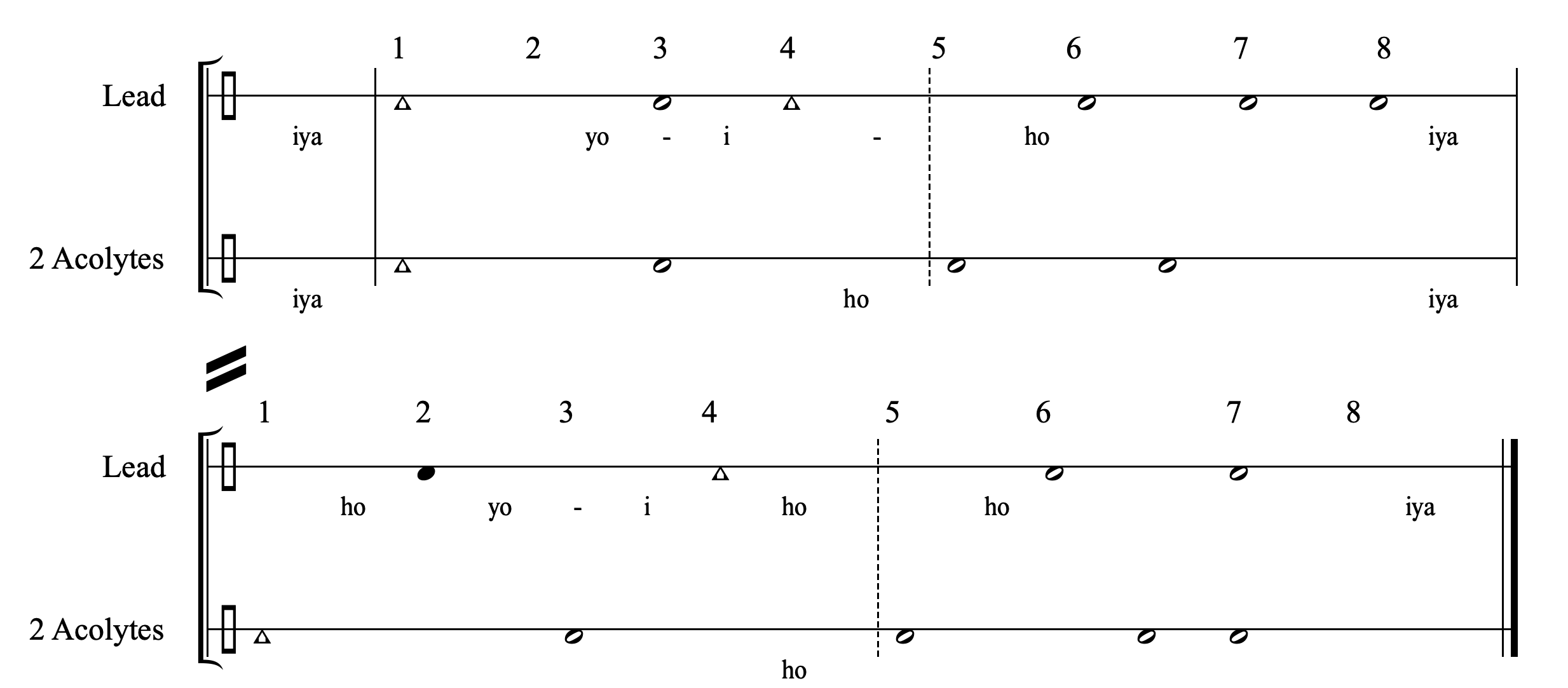
The percussion part is based on four principal patterns. Patterns 1 and 2 are used in the first two parts, while variations of Pattern 1, together with Patterns 3 and 4, appear in the third part.
As for the nohkan, its Okina-no-mai pattern comprises thirteen phrases. The register of the opening shōga of each phrase traces an arch-shaped melodic contour, from low to high and back to low, as outlined in the chart below. The chart also maps the structure of the dance, indicating the number of honji corresponding to each nohkan phrase, the associated percussion pattern, and the title for each sequence of stamps.
| Honji | Nohkan’s phrase | Percussion pattern | Named sequences of three stamps: L-R-L |
| Part I | |||
| 1-4 (26’27”) | 1 – Low | Pattern 1 | |
| 4-5 (27’20”) | 2- Low | Pattern 1 | |
| 6-7 (27’49”) | 3 - High | Pattern 1 | |
| 8 (28’18”) | - | Pattern 2 | Heaven |
| Part II | |||
| 9-10 (28’39”) | 4 - Middle | Pattern 1 | |
| 11 (29’08”) | 5 - Middle | Pattern 1 | |
| 12-13 (29’22”) | 6 - Low | Pattern 1 | |
| 13 (29’36”) | 7 - High | Pattern 1 | |
| 14 (29’51”) | - | Pattern 2 | Earth |
| Part III | |||
| 15-19 (30’12”) | 8 - Low | Pattern 1- variation | |
| 20-25 (30’28”) | 9 – High | Pattern 1- variation | |
| 26-32 (31’00”) | 10 – Middle | Pattern 3 | |
| 33-34 (31’41”) | 11 – Low | Pattern 1- 2nd variation | |
| 35-38 (31’52”) | 12 – Middle | Pattern 1- 2nd variation | |
| 39-41 (32’11”) | 13 – Very low | Pattern 4 | Man |
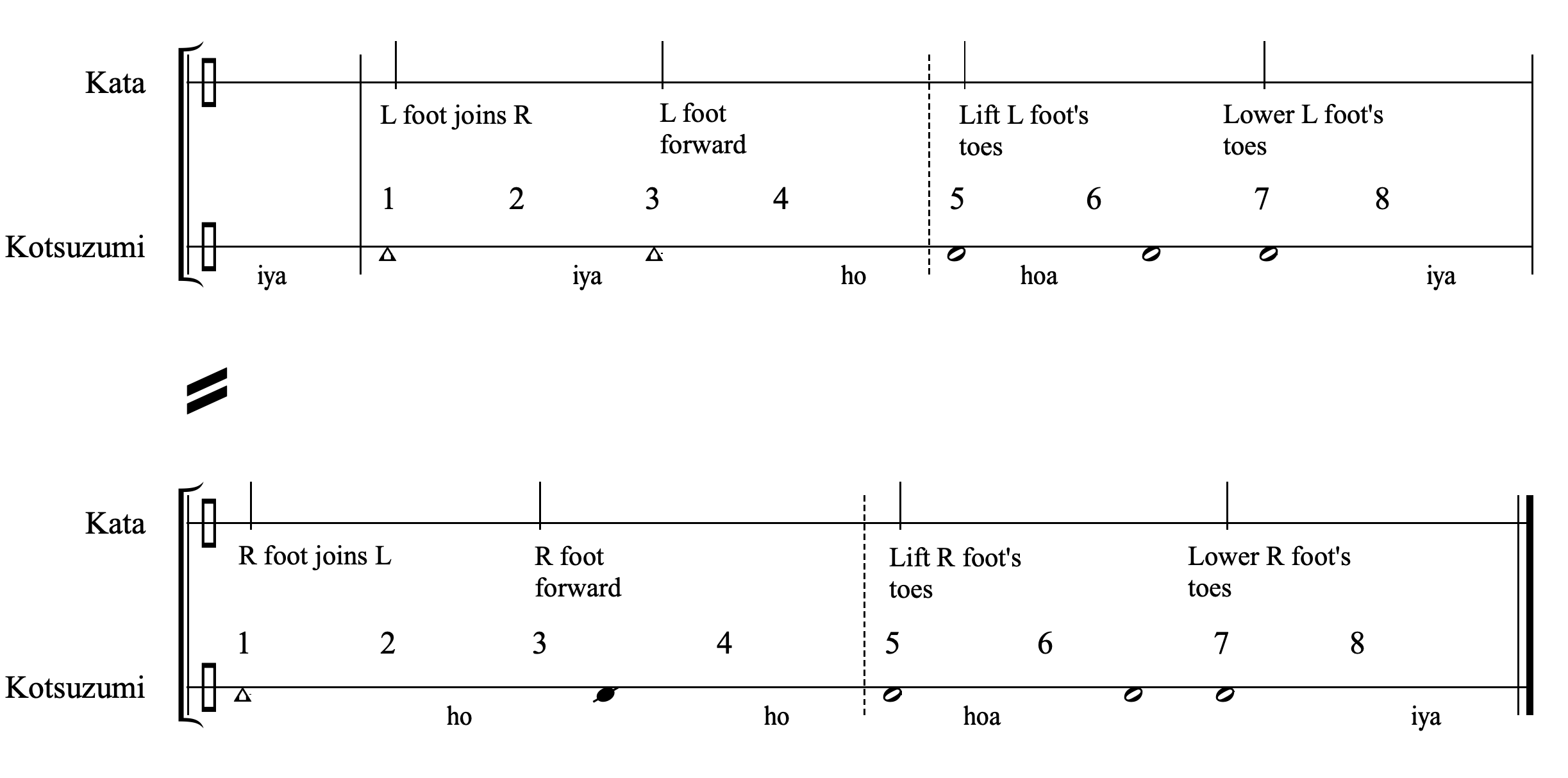
Part I opens with the kotsuzumi’s first pattern, which is composed of two sections. The initial section includes strokes on beats 1, 3, 5, and 7, the first three preceded by a kakegoe and the last accompanied by an anacrusis. The second section is a variation, featuring strokes on beats 1, 3.5, 5, and 7. The tempo is very slow, with Okina’s steps on beats 1, 3, 5, and 7, in rhythmic synchrony with the percussion, as shown in figure below.
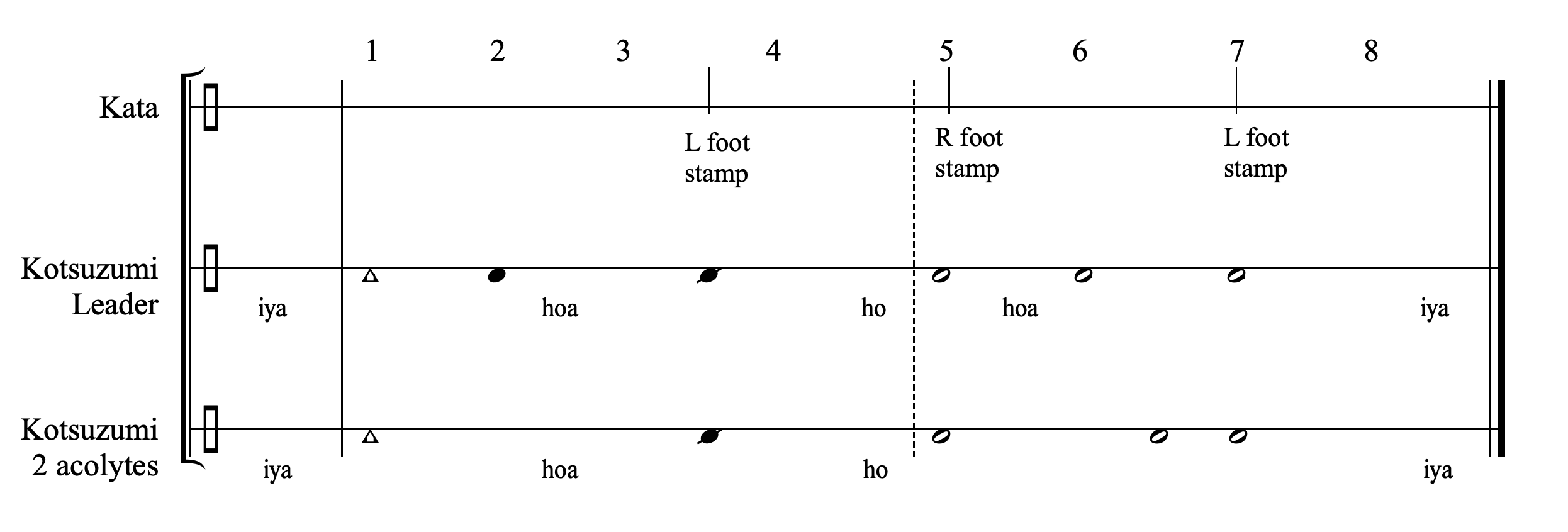
Both Part I and Part II conclude with a sequence of three stamps on beats 3.5, 5, and 7. In both cases, the ōtsuzumi’s ‘chin’ stroke on the second beat triggers the stamping, always set against the same percussion texture, shown in figure below. The Heaven pattern—Left–Right–Left—closes Part I (measure 8), while the Earth pattern—Right–Left–Right—concludes Part II (measure 14).
Part III is performed at a fast tempo. At measure 26, the shite assumes a posture rarely seen in Noh, covering his face with his fan and raising his left sleeve overhead. The percussion part, as if reacting to this unusual gesture, introduces its third pattern one measure later, shown in figure below, with all three kotsuzumi parts rhythmically synchronized.
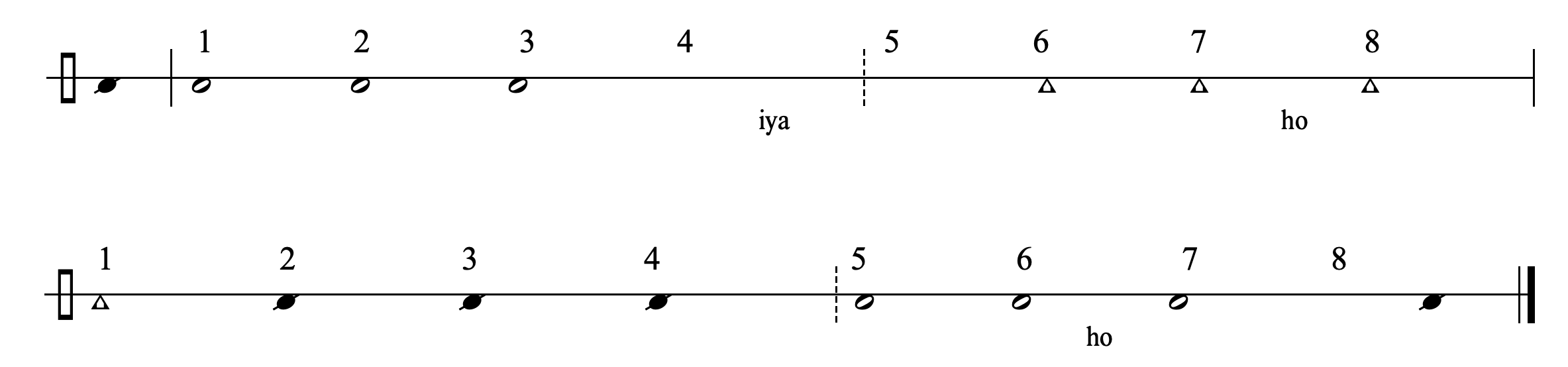
Finally, Pattern 4 (shown in figure below) splits the kotsuzumi trio into two groups and supports Okina as he concludes the shōdan with the Man stamping pattern—Left–Right–Left—on beats 7 and 8, the last one falling on the first beat of the next shōdan.