Shōdan in Okina
Mominodan
This instrumental dance comprises six sections, each demarcated by the nohkan’s patterns. The duration of each section, measured in honji, is indicated in parentheses following the section and pattern names:
| Six Sections of Mominodan | |||
| Section | Measure (Honji) | Nohkan Pattern | Dance Sections (measures) |
| Kakari (2) | 1-2 | Kakari (2) | Round 1 (1-14) |
| I (30) | 3-7 | Ji-a (5) | |
| 8-12 | Ji-b (5) | ||
| 13-14 | Ji-c (5) | ||
| 15-17 | Round 2 (15-27) | ||
| 18-22 | Ji-d (5) | ||
| 23-25 | Sho-te (3) | ||
| 26-27 | Te-a (7) | ||
| 28-32 | Round 3 (28-43) | ||
| II (16) | 33-37 | Ji-e (5) | |
| 38-40 | Ni-no-te (3) | ||
| 41-43 | Te-b (8) | ||
| 44-48 | Round 4 (44-58) | ||
| III (14) | 49-53 | Ji-f (5) | |
| 54-56 | San-no-te (3) | ||
| 57-58 | Te-c (6) | ||
| 59-62 | Round 5 (59-72) | ||
| IV (15) | 63-67 | Ji-g (5) | |
| 68-72 | Ji-h (5) | ||
| 73-77 | Ji-i (5) | Round 6 (73-85) | |
| Tome (8) | 78-85 | Tome (8) | |
Apart from the Kakari and Tome, the nohkan signals the beginning of each of the other four sections with a ji pattern composed of five phrases, labelled A, B, C, D, and E. The first three are each followed by an X-no-te pattern, which is identical to the Ji’s first three phrases (A, B, and C), as illustrated below:
| Ji | A | B | C | D | E |
| Sho-, Ni-, and San-no-te | A | B | C | – | – |
The register of the opening motives of each phrase outlines an arch-shaped melodic contour: the line moves from the instrument’s high register to medium-low, before returning to the high register.
| A | B | C | D | E |
| high | high low | medium low | medium high | high |
The final part of each of the first three sections is called Te. The Te phrases differ in content from those of the Ji. The register of the opening motive of each Te phrase (labelled F, G, H, I, J, K, L, and M) follows a distinct trajectory: it begins in the medium-low register, descends to low, and finally rises to the high register:
| F | G | H | I | J and K | L | M |
| medium low | low medium | low | low high | medium low | medium high | high |
The three Te sections differ in duration. Te-b is the longest, using all eight phrases in the order illustrated above. By contrast, Te-a and Te-c omit some phrases, as detailed below:
| Te-a | F | G | ― | I | J | K | L | M |
| Te-b | F | G | H | I | J | K | L | M |
| Te-c | F | G | ― | ― | J | K | L | M |
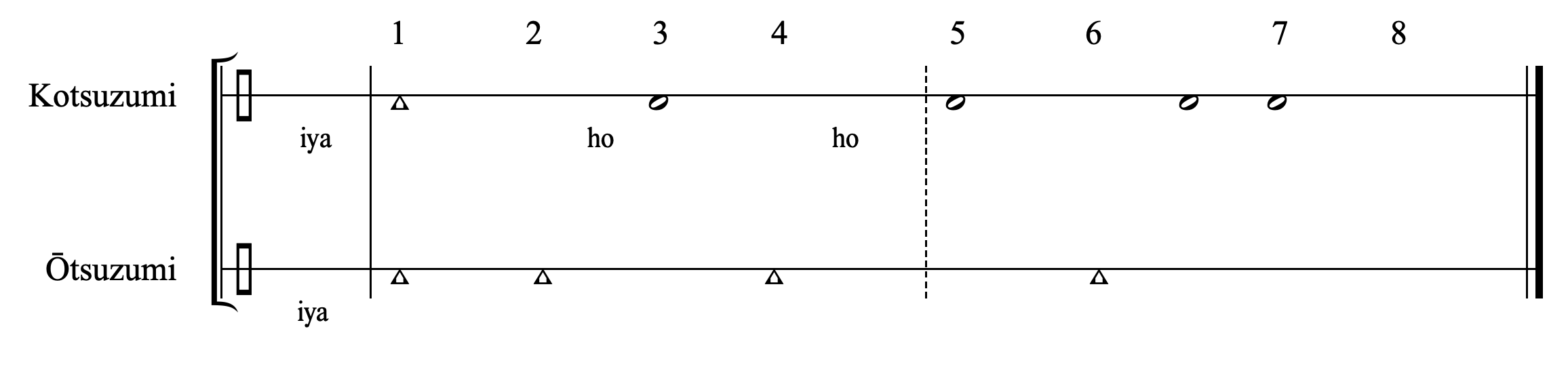
Percussion support centers on the kotsuzumi’s one-honji pattern, first introduced in Okina’s Shiku-no-kamiuta. This pattern includes a stroke every second beat, with each of the first three strokes preceded by a kakegoe: “iya” for the first, and “ho” for the second and third. The stroke on the seventh beat, however, is preceded by a pick-up “po” stroke rather than a kakegoe.
As for the ōtsuzumi, while its function in the Momidashi was to interact with the kotsuzumi’s steady pattern, here the emphasis is on supporting the dance. Accordingly, its pattern is steady, featuring “chon” strokes on most even beats—1, 2, 4, and 6—which complement the kotsuzumi’s strokes on the odd beats:
Throughout these six sections, Sanbasō’s dance unfolds in a sequence of six distinct rounds across the stage. Each round features a variation on three fundamental movements: sleeve swirling or turning (emphasizing the upper body), stamping steps (shifting energy toward the lower body), and circling to the left or right. Each round is composed of up to three elements in a fixed order: hand movement, stampings, and circling; however, some rounds do not include all three elements.
The dance sequence is illustrated in the chart below.
| Round | Measure | Arm position | Stamping | Circles |
| 1 | Measure 1-14 | Held in front, then open | In the first half | 1 to the left |
| 2 | Measure 15-27 | Held in front, then open | No | 3 to the left |
| 3 | Measure 28-43 | Right on the right shoulder, left outstretched with occasional swirls | In the first half | 2 to the right |
| 4 | Measure 44-58 | Both on the shoulders | In the first half | 2 to the left |
| 5 | Measure 59-72 | Both on the shoulders, then left outstretched after a swirl | Throughout | 2 to the right |
| 6 | Measure 73-85 | In motion, then held in front | Jumps and then stamps after the circles | 2 to the left |
Most rounds conclude with a walked circle, with Sanbasō alternating between left and right directions. Each circle begins at Square 8. For a left circle, he first moves to the right, tracing a path through Squares 8, 5, and 3. For a right circle, he moves left, following a trajectory that includes Squares 8, 3, and 5.
These circlings vary in size. The larger circles are roughly triangular in shape; some begin with stamping, but all include two turns at the front of the stage—Squares 5 and 3. Smaller circles include either a single turn or, in some cases, none at all.
In Noh performance, as in Shinto practice, sequences of dance movements traditionally give priority to the left direction. This custom is symbolized by the word sayū, meaning “left and right.” The same rule applies to the Sanbasō dance sequence: the dance begins with four consecutive left circles in rounds one and two, followed by two right circles in round three. This alternation continues throughout the performance.
It is notable that the Kyōgen actor, while dancing Sanbasō, shouts kakegoe such as ‘iya’, ‘ya’, and ‘ha’—a highly exceptional practice for a Noh actor, who would not typically make such vocal calls. These kakegoe add liveliness and a dynamic atmosphere to the Sanbasō dance. The energetic stamping sequences are often accompanied by Sanbasō’s kakegoe, with ‘iya’ on beat 8.5 and ‘ho’ on beat 4.5. Conversely, the quieter walking motions are usually performed without any kakegoe.
Thus, the movements and postures of the Sanbasō dancer are highly distinctive, aligning closely with those found in the later Suzunodan.