Shōdan in Okina
Shiku-no-kamiuta
Okina’s song shiku-no-kamiuta features a regular text set in sashinori, sung in the tsuyogin style, accompanied by a non-congruent nohkan part and a steady beat established by three kotsuzumi drums in a strict rhythmic setting.
The text is divided into three sections. The first and third sections appear to be based on a lost language—one seemingly derived from shōga, the onomatopoeic syllables used to mimic the sounds of percussion and wind instruments. In contrast, the text of the second section, which consists of four phrases of seven plus five syllables, reflects the style of imayō—a song form popular during the Heian (794–1185) and Kamakura (1185–1333) periods. Notably, closer inspection reveals that the first and third sections also adhere to the imayō structure, despite certain irregularities in phrasing. For this reason, some researchers have referred to this shōdan as shiku no kami-uta—literally, a “divine song composed of four phrases.”
In the first section, the three kotsuzumi introduce two distinct eight-beat patterns. The first pattern is built on two sounds: the 'ta' and 'po' strokes, with 'ta' consistently used in the first half and 'po' in the second. Strokes occur on beats 1, 3, 5, and 7, each preceded by a kakegoe, except beat 7, which follows an anacrusis on beat 6.5.

The second pattern appears briefly in the sixth and seventh honji, foreshadowing the beginning of the song's second part by two honji. It is identifiable by the lead kotsuzumi player performing a variation on the primary pattern, diverging from the two accompanying players. This variation includes combined strokes on beats 1, 3, 4, 5, 6, 6.5, and 7, for a total of seven strokes compared to five in the first pattern:
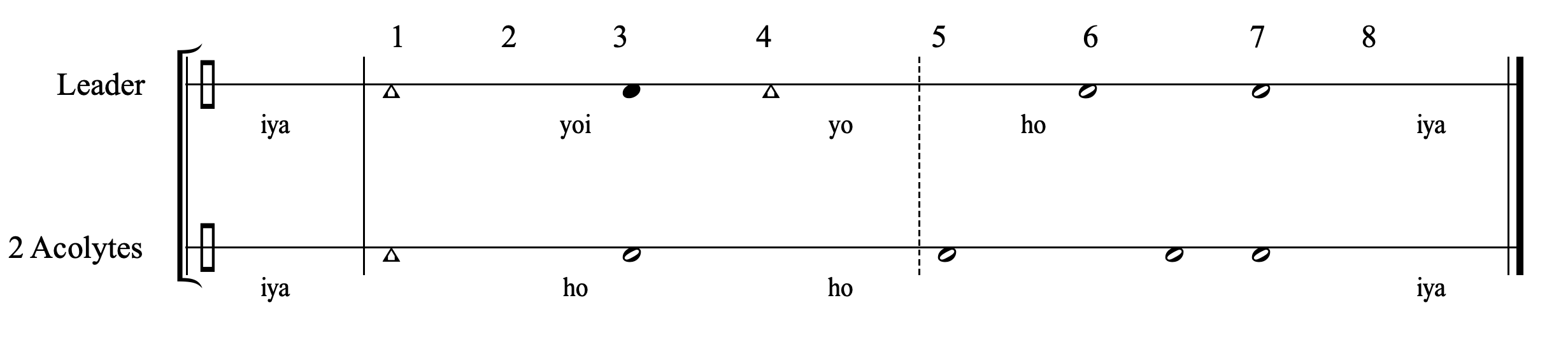
Following the initial instrumental section, the second section is marked by the entrance of the vocal part and the nohkan’s Hacchō-no-yuri pattern. The text draws on an archaic origin, resembling onomatopoeic representations of flute and percussion, and the singing alternates between Okina and the jiutai.
The nohkan’s Hacchō-no-yuri comprises four continuous phrases, whose opening motives descend in register: the first phrase ‘O-hya’ begins in the high register; the second ‘Hi-ya’ is in the middle; the third ‘Hi-u’ is in the lower; and the fourth ‘Ho-hya’ concludes in the lowest register.
In the third section, with the nohkan tacet and the text returning to onomatopoeia, the three kotsuzumi introduce a new four-beat pattern, which is rhythmically faster, alternating 'chi' and 'po' sounds. The symmetrical sequence of strokes and kakegoe divides the honji into two four-beat segments.

Across the six honji of this third section, the tempo accelerates from MM = 50 to MM = 112 by the fifth honji; a deceleration to MM = 66 in the sixth and final honji marks the cadence. The nohkan, silent since the beginning of the section, concludes the song with its Hishigi pattern.