Shōdan in Okina
Suzunodan
Suzunodan is an instrumental dance comprising six instrumental sections, each articulated by nohkan patterns. The table below presents these musical sections and their corresponding dance sections.
| Six Music Sections of Suzunodan | |||
| Music Section | Measure | Nohkan Pattern | Dance Sections (Measures) |
| Introduction (6) | 1-6 | Jo | Introductory Section (1-6) |
| I (33) | 7-11 | Ji-1 | Section I (7-11) |
| 12-16 | Ji-2 | Section II (12-20) | |
| 17-21 | Ji-3 | ||
| 22-26 | Ji-4 | Section III (21-26) | |
| 27-39 | Te-1 | Section IV (27-39) | |
| II (18) | 40-44 | Ji-5 | Section V (40-57) |
| 45-57 | Te-2 | ||
| III (15) | 58-62 | Ji-6 | Section VI (58-67) |
| 63-67 | Ji-7 | ||
| 68-72 | Ji-8 | Section VII (68-85) | |
| IV (12) | 73-76 | Suzu-kudaki | |
| 77-85 | Tome-no-te | ||
| Tome (2) | 86-87 | Tome | Closing Section (86-87) |
The nohkan phrases in the introductory section (measures 1–6) are the same as those played in the introduction to Kagura, an instrumental piece depicting divine possession. The nohkan concludes these introductory phrases with the hishigi tone, which signals the transition to Suzunodan’s first main section. It consists of four repetitions of the Ji pattern, followed by a Te pattern.
In Okina’s Suzunodan, nohkan patterns are reused across various sections, creating a web of interconnections. The Ji section itself consists of five honji, with an “aabcd” structure—the second honji repeating the first. The first three honji of the Ji correspond directly to the first three honji of the Te. The first two align with the initial pair in Suzu-kudaki, and the very first honji recurs in the opening five honji of the Tome-no-te. Through this intricate reworking of musical phrases, the nohkan part acquires a notably cyclical character.
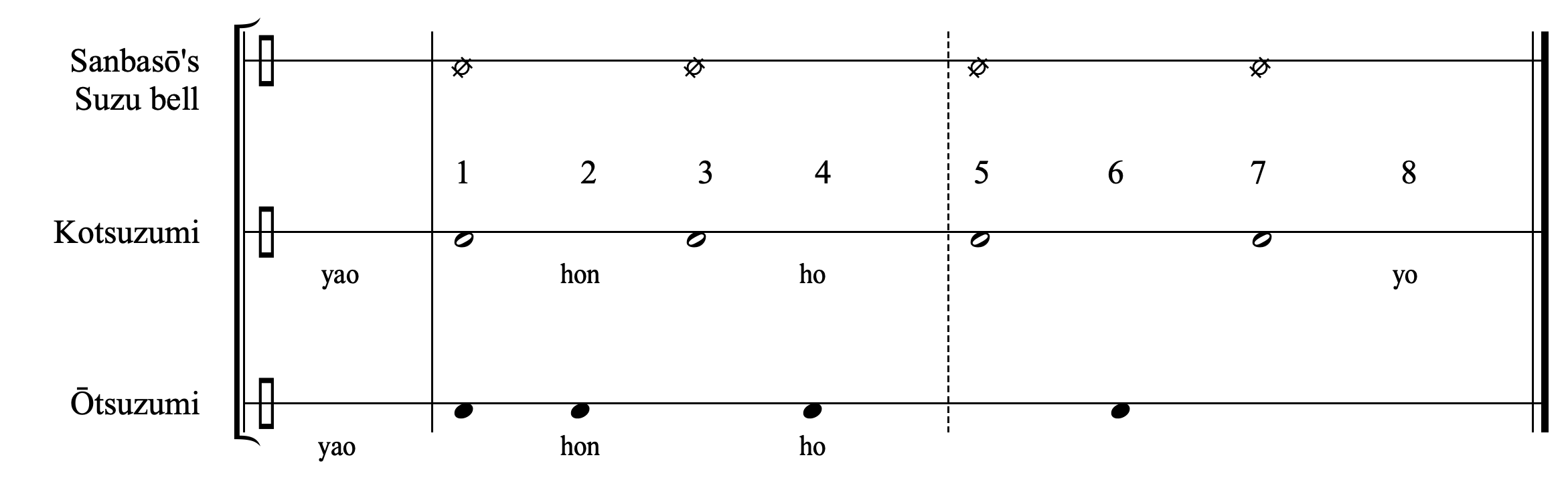
As in the Mominodan, the three kotsuzumi players introduce a one-honji pattern—repeated throughout the dance—that features strokes on beats 1, 3, 5, and 7. The ōtsuzumi, meanwhile, repeats its own pattern, predominantly emphasizing the even beats: 1, 2, 4, and 6.
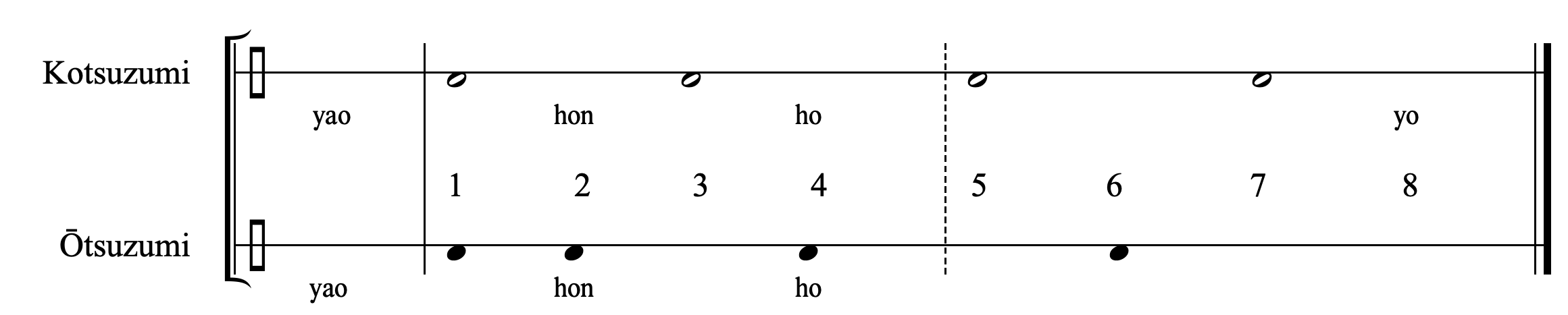
During stamping sequences, the ōtsuzumi switches to a three-honji pattern that nearly aligns with the kotsuzumi’s strokes on the odd beats, except for a stroke on the sixth beat. This sparser but dynamically stronger percussive texture complements well the dynamic stamping.
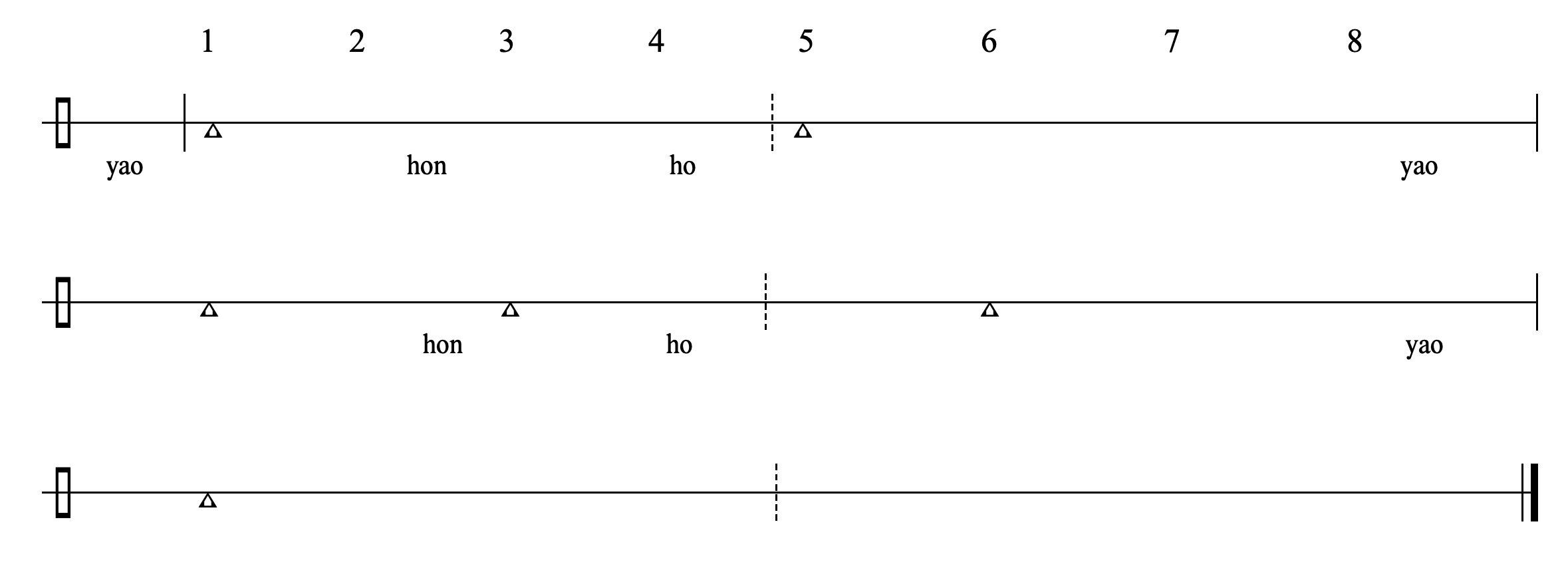
The choreography of Suzunodan consists primarily of three elements: Sanbasō ringing the suzu bell in his right hand, stamping, and circling the stage. From the start of Section I’s first Ji until near the conclusion, Sanbasō strikes the suzu bell on beats 1, 3, 5, and 7, synchronized with the kotsuzumi’s po strokes.
Sanbasō rings the bell in four distinct positions: knee level (low), hip level (middle), arm’s length (middle), and a raised, full extension of the arm (high)—each position successively intensifying the dance’s mood from subdued to dynamic.
Dividing the dance sequence into discrete sections is challenging. Here, however, we have chosen to use the recurring stamp patterns as markers for smaller dance sequences. Following this approach, the choreography of the main part of the dance—excluding the introduction and closing—can be described as comprising seven sections.
Each section has its own positioning, movement, and mimicry. The chart below illustrates the overall shape of the dance sequences. From this analysis we may speculate that the first half (Sections 1 to 4) focuses on purification by Sanbasō, and the latter (Sections 5 and 6) on his possession.
| Sections | Holding Position of Bell (high middle low) | Main position the Sanbasō occupies on stage | Circling | Mimetic choreography | |
| Introductory Section (1-6) | Square 9 | Circling Left | Tappai (Ritualistic Prayer) | ||
| Section I (7-11) | high to low | Square 9 | Purify Square 9 | Purification | |
| Section II (12-20) | low, middle and to high | Square 3 | Purify Square 3 | ||
| Section III (21-26) | high | Square 5 | Purify Square 5 | ||
| Section IV (27-39) | high to low | Square 1 | Circling Left | Purify Square 1 | |
| Section V (40-57) | low to middle | Square 1 and 8 | 2 Right Circlings | Possession | |
| Section VI (58-67) | low to high | Square 9 | Omo-gaeri (“turn back the face”) | ||
| Section VII (68-85) | high | Circling and Square 9 | 2 Left circlings | Suzu kudaki (“Shatter and Splash the bell”) | |
| Closing Section (86-87) | Square 9 | Tappai (Ritualistic Prayer) |