Masks
By Diego Pellecchia
Introduction
There are over 200 types of noh masks, grouped in categories, types, and variant types. One of the most common subdivisions conceives of five groups: god masks, female masks, male masks, spirit masks, and demon masks. Masks used in the ritual performance Okina constitute an additional category. Kyōgen masks are categorized separately.
Most noh masks are associated with a character type (e.g. young woman, middle-aged woman, warrior, demon, etc.) and each shite school may prescribe a certain character in a specific play to be performed with different types of mask. There are only a few masks that are used exclusively to portray one character (e.g. Yamanba, Shunkan, Semimaru). Also, while most mask types are employed across schools, some others are specific to certain schools. For example, the same role of young woman may be portrayed with a woman mask called Waka-onna (Kanze school), Fushiki-zō (Hōshō school), Magojirō or Ko-omote (Kongō school), or Ko-omote (Konparu and Kita schools).
Historically, the masks associated with the ritual performance Okina occupy a special position. They have roots in performance traditions predating the development of noh in its present form, and surviving examples date back to the Kamakura period (1185–1333). The oldest surviving Hakushiki-jō mask bearing an original dated inscription, from 1278, is now preserved in the Ethnologisches Museum in Berlin. Unlike most masks used to portray characters in noh plays, the masks of Okina and Sanbasō possess a special sacred status as objects embodying deities. This distinction is also reflected in the way they are handled during performance.
The masks used in noh plays developed as sarugaku noh was taking shape during the early Muromachi period (1336–1573), although some examples may be older. These early masks were probably created in response to the needs of performers, who commissioned mask carvers to produce masks suited to particular roles. Unlike later reproductions, early works often display a remarkable sense of individuality, vitality, and realism, reflecting the creative freedom of their makers.
Mask types continued to develop throughout the Muromachi period, and their use was largely canonized by the beginning of the seventeenth century. In the late sixteenth century, certain masks of each type came to be regarded as superior examples and became standards (honmen) that were subsequently copied using techniques still employed today. Each honmen has a name (e.g. Kojō, Chūjō, Tobide), which is retained by its copies (utsushi), thus establishing a recognizable iconography for each mask type. Excellent utsushi masks made according to the dimensions and expression of the honmen became viable theatrical tools and are regarded as possessing their own intrinsic identity. As honmen serve as reference masks, the process of producing utsushi has also given rise to numerous variations, expanding the range of possibilities available to performers in their portrayal of characters.
Noh masks are carved using only natural materials and hand tools. A single block of hinoki (Japanese cypress) is carved into the shape of the mask, then covered with a white primer made with crushed shell and animal glue. The mask is then painted with natural pigments and, depending on the type, covered with thin layers of brownish paint that create a patina of age while adding depth and highlighting details. Finally, the carver may deliberately scratch or scar parts of the mask to give it an older appearance. No fixing agent or varnish is added on top of the mask, making it prone to further damage.
Today both ancient masks and copies are used in performance. Regardless of age, actors treat masks with the utmost care, bowing to them before using them in performance to express respect for the tradition they represent. It is thanks to this carefulness that ancient masks can still be used on stage today, after centuries of use.
Takasago
In the first half of the play, the old man and woman wear masks that portray refined elderly figures. Although their appearance is human, the masks suggest an underlying dignity appropriate to their true identities as the spirits of the pine trees of Sumiyoshi and Takasago.
In the second half, the main character returns in his divine form as the deity of Sumiyoshi. The choice of mask can vary according to the school and performance tradition, ranging from relatively naturalistic male masks to more expressive types that emphasize the deity’s supernatural power.
The contrast between the masks used in the two halves of the play reflects one of the central conventions of noh: the gradual revelation of a supernatural being initially concealed beneath an ordinary human appearance. In Takasago, this transformation also corresponds to a shift in the performance, from the restrained movements of the elderly couple to the energetic dance of the deity, celebrating longevity, harmony, and prosperity.
First Act Mask: ‘Ko-jō’
Among the various jō masks representing elderly men, Ko-jō (小尉) is distinguished by its particularly refined and dignified appearance. It is used for characters of elevated status, especially deities who appear in human form during the first half of a noh play. In Takasago, it represents the old man who is eventually revealed to be the deity of Sumiyoshi.
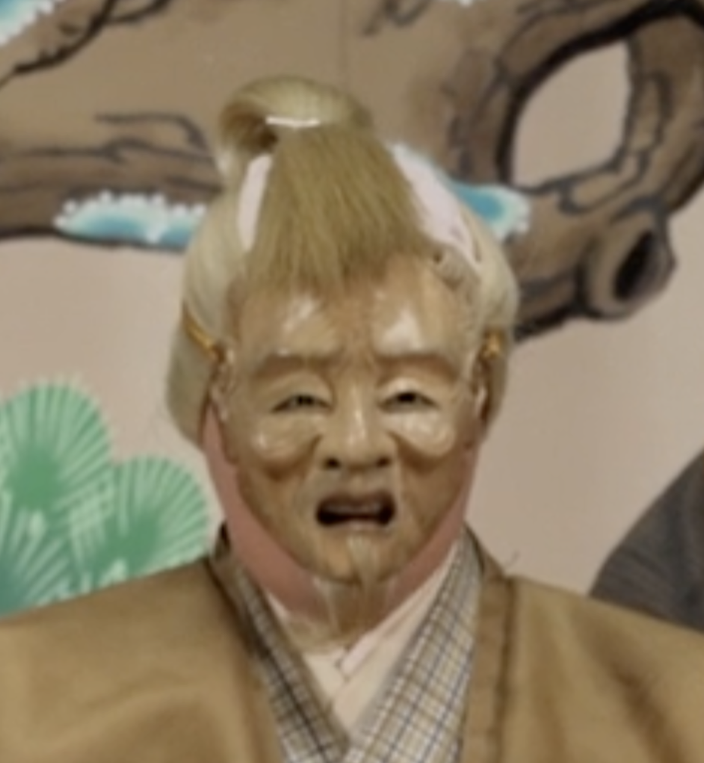
Compared with other old-man masks, Ko-jō has relatively few wrinkles, a small mouth revealing only the upper row of teeth, and a finely modeled face. The cheeks are slightly sunken, making the cheekbones visible. Another important feature is the treatment of facial hair. Unlike many other old-man masks, which have implanted mustaches, Ko-jō generally has a painted mustache and an implanted beard. The eyebrows are also painted rather than made of inserted hair.
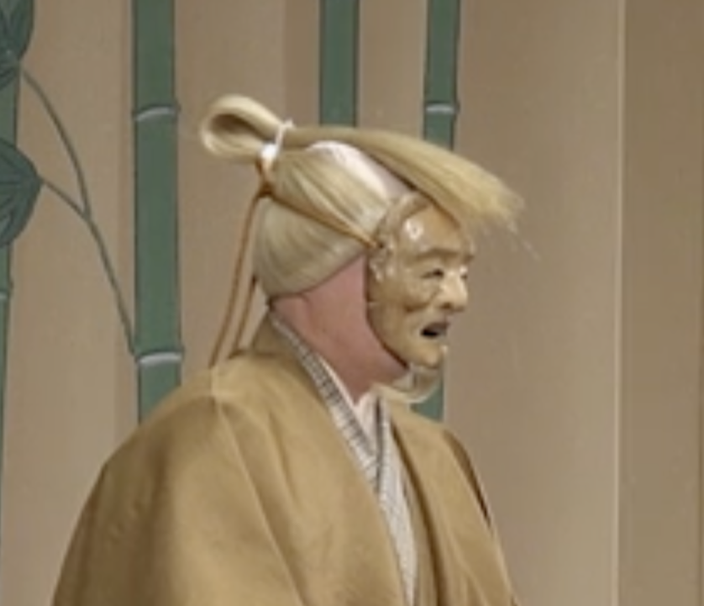
These features give Ko-jō a more refined appearance than other masks representing elderly men. Its restrained expression and delicate facial proportions are particularly appropriate for portraying a deity temporarily disguised as a human being.
The Ko-jō mask used in this performance is traditionally attributed to the early mask carver Koushi (小牛) and is also known as Koushi-jō (小牛尉). Its exceptionally accomplished carving recalls the sculptural traditions of the Kamakura period (1185–1333), giving the face a remarkable sense of vitality and realism. Considered one of the finest surviving examples of early Ko-jō masks, it is among the most prized masks in the Kongō iemoto collection, alongside the Hakushiki-jō attributed to Miroku.
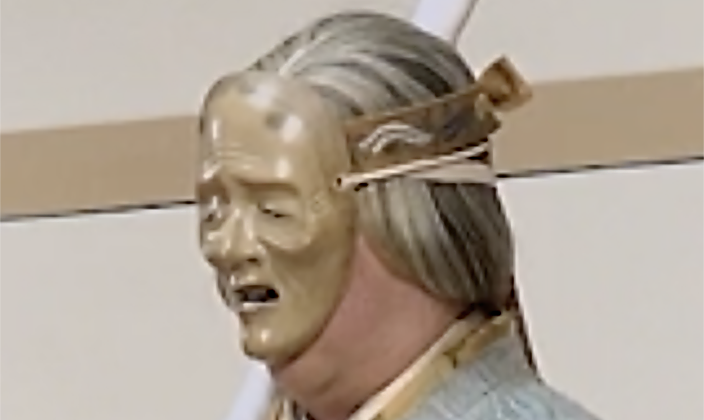
First Act Tsure Mask: ‘Uba’
Uba (姥), meaning ‘old woman’, is a mask used for elderly female characters. It is particularly associated with subsidiary roles (tsure) in the first half of noh plays, where a deity or spirit appears in the form of an old woman. In Takasago, it represents the wife of the old man, who is eventually revealed to be the spirit of the Takasago pine.
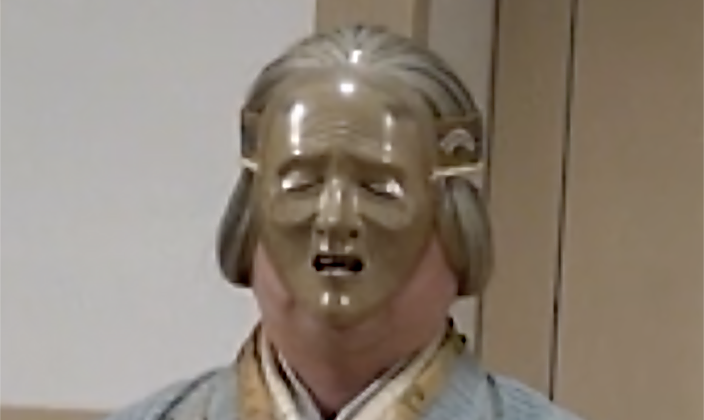
The mask portrays an elderly woman through a combination of subtle wrinkles, sunken cheeks, and a relatively thin face, with slightly protruding cheekbones. The forehead and the area around the eyes show signs of age, but the overall expression remains gentle and dignified.
One of its distinctive features is the shape of the eyes. Unlike most female noh masks, which have small rectangular openings for the pupils, Uba has elongated openings extending across the eyes from one corner to the other. The eyelids are slightly lowered, giving the mask a downward-looking gaze.
The hair is painted with a central parting and a mixture of black and gray strands, suggesting advanced age and matching the wig worn by the performer. The small mouth reveals only the upper row of teeth, which are painted black, reflecting historical Japanese customs of tooth blackening.
Despite its aged appearance, Uba retains a certain elegance. The mask is not intended to portray physical decline alone, but rather the dignity and serenity of old age.
Second Act Mask: ‘Mikazuki’
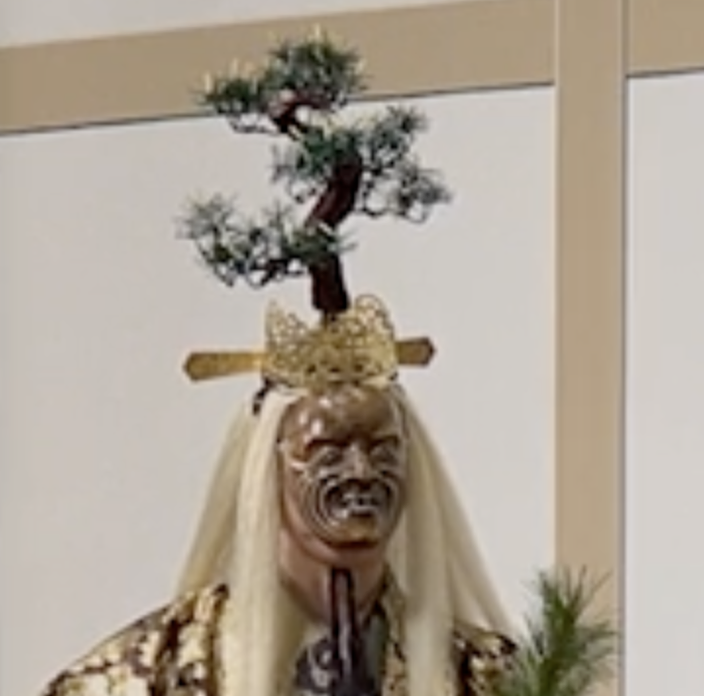
Mikazuki (三日月) is a mask used to portray powerful supernatural beings, including malevolent spirits, warrior ghosts, and certain deities. Although its fierce expression is often associated with threatening characters, it can also represent benevolent gods. In Takasago, it may be used for the deity of Sumiyoshi, who appears in the second half of the play.
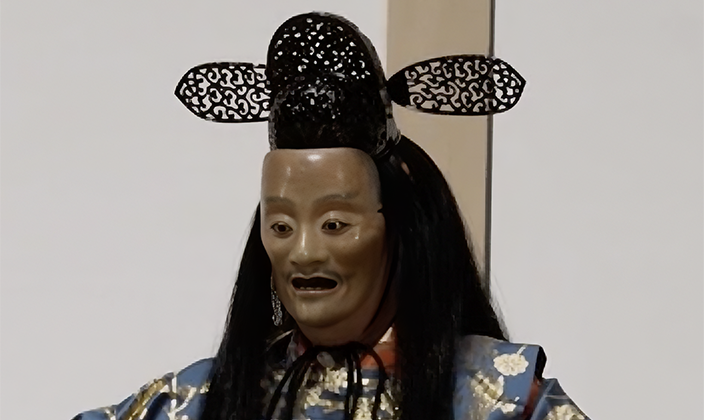
The mask is characterized by its strong facial features, particularly its glaring eyes and slightly open mouth, which may reveal both rows of teeth. The expression suggests a powerful supernatural presence, as though the character were shouting, breathing heavily, or displaying an intense concentration of energy.
The complexion varies among individual examples, ranging from whitish tones to reddish or brown. The eyebrows are painted in their natural position, often with sharply pointed shapes. The mustache and beard are also painted, emphasizing the mouth and the overall intensity of the expression.
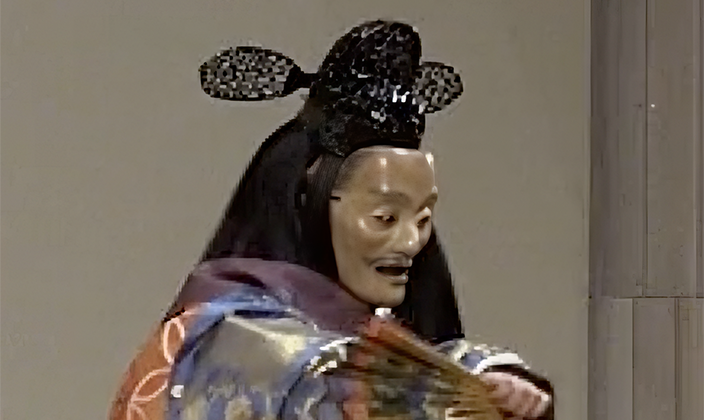
One of the most distinctive features is the treatment of the eyes. Unlike most masks representing human characters, in which the eyelids partially conceal the eyes, Mikazuki has large, rounded eye openings. The eyes are often highlighted with gold paint or metallic inserts, a convention used in noh to indicate the supernatural nature of a character.
A black line running along the upper edge of the mask marks the position of the lacquered headgear worn by the performer. Depending on the variant, the painted hair may appear neatly arranged or disheveled.
The combination of glaring eyes, sharply modeled features, and a gaping mouth creates an impression of extraordinary power. When used for the deity of Sumiyoshi in Takasago, the mask emphasizes the god’s youthful and supernatural identity and the energetic character of the final dance.
The Mikazuki mask used in the performance documented here was made by Deme Tōhaku Mitsutaka (出目洞白満喬), one of the most distinguished noh mask carvers of the seventeenth century.
Hashitomi
Mask: ‘Ko-omote’
The name Ko-omote (小面) literally means ‘small face’, but refers to the mask’s cuteness rather than its size. The use varies depending on the shite school. Kongō school uses Ko-omote to portray any kind of young female character: from a country girl to a court lady, from a flower spirit to a goddess.

Ko-omote represents the idealized face of an aristocratic young woman from the Heian period (794–1185), which was considered as the standard of elegance in medieval Japan. Ko-omote masks feature a fair complexion, with three thick hairlines neatly combed along the sides and fuzzy eyebrows painted high on the forehead. The teeth are dyed black. This make-up and hairstyle follow Heian-period aesthetics, though the mask may be used to portray any kind of female character, even from later eras. The mask’s plump cheeks and small lips, and the proportions of the small triangle formed between the eyes, nose and mouth give the mask a youthful look.

The mask is used in combination with a long black wig (kazura) which, in the case of Hashitomi, is kept bound behind the neck, and hidden under the upper garment. The hair wig is parted in the middle and combed along the sides of the face, in correspondence with the painted hair. The ears of the actor are hidden under the hair.
In the case of Hashitomi, Ko-omote is the standard choice in the Kongō school to represent the face of Yūgao, a young aristocratic lady from the Heian period. The Kanze school uses Waka-onna, offering the alternatives of Ko-omote and Fukai, the mask of a middle-aged woman. The Hōshō school uses its standard young woman mask, Fushikizō.

The Shimo-gakari shite schools (Konparu, Kongō, and Kita) use Ko-omote for both shite and tsure (companion) roles, though they often distinguish between specific Ko-omote masks reserving certain ones for shite roles and assigning others with less complex expressions for tsure roles. The Kongō school treasures one of the most famous Ko-omote masks, called Yuki-no-Ko-omote (snow Ko-omote), which is said to have been created by the renowned mask carver Tatsuemon in the Muromachi period (1338–1573).
Kokaji
First Act Mask: ‘Dōji’
The name Dōji (童子) literally means ‘boy’. The mask is used invariably for either a deity or a spirit in disguise in the first half of a play (e.g. Tamura, Kokaji, Shakkyō) or for roles of Chinese immortal (Makura-jidō, Hōsō, etc.). According to noh conventions, masks are not used for roles of adult males, unless the character is the personification of a supernatural creature or some other kind of special character.


The mask represents the face of a boy, with natural eyebrows, elongated eyes, and a natural smile. The expression is devoid of any wrinkle or furrows, contributing to a youthful look. The painted uncombed hair suggests a young age and is matched with the large black kashira wig used in combination with this mask.

Second Act Mask: ‘Kotobide’
The mask used in the second half of the play may depend on the shite school and on the performance variant. The typical choice for the standard version of the play is Kotobide (小飛出). The name of this mask means ‘small jump/pop-out’ and it describes its eyes, which appear as if they were popping out of the eye-sockets. ‘Small’ refers to the fact that there is a ‘large’ version of the mask (Ōtobide), used in other contexts. Kotobide is used for roles such as the deity of Mt. Inari in the form of a fox-god (Kokaji) or the evil fox-spirit Tamamo no mae (Sesshōseki).

While the standard Kotobide has a reddish complexion, in the Kongō school performance analyzed in this website a variant type of the same mask, called Dei-kotobide (‘golden Kotobide’) was used instead. Dei-kotobide is entirely covered with gold paint and features golden metal inserts for the eyes. According to noh conventions, gold symbolizes the supernatural nature of a character. The arched eyebrows, open wide round eyes, open mouth, and pointed mustache give the impression of an outburst of energy. Depending on the school and performance variant, the mask is used in combination with red or white kashira wig.

The sculptural features of a mask differ from item to item. The one used in the performance filmed for this project is essentially the same as the standard Kotobide, except that its surface is painted gold instead of red. However, other Dei-kotobide are closer to the larger Ōtobide, which is used for the rain and thunder deity Wake-ikazuchi in Kamo, or for performance variants of Kokaji.
The mask used in the performance filmed is a Dei-kotobide carved by Iseki Bitchū no jō (Momoyama period).
Ai-kyōgen Mask: ‘Noborihige’
Noborihige (登髭), meaning ‘rising beard’, is a kyōgen mask representing the face of a rustic old man. It is commonly used to portray supernatural characters, particularly lesser deities (massha) appearing in kyōgen interludes for noh plays in the standard canon, although it may also be used in other contexts.

The mask has a dark complexion, deep wrinkles on the forehead and cheeks, and crescent-shaped eyes that give it a cheerful, smiling expression. Its mouth is open, sometimes revealing a few irregular teeth or gaps where teeth are missing. Its most distinctive feature is the implanted facial hair that rises along the sides of the face, giving the mask its name. Additional hair may be implanted on the chin, while the mustache is generally painted.

The combination of exaggerated wrinkles, upward-pointing sideburns, and broadly smiling eyes creates an expression that is both humorous and otherworldly. These features distinguish Noborihige from the more naturalistic old-man masks used in noh and make it particularly suitable for the portrayal of supernatural beings in kyōgen.
In Kokaji, Noborihige is worn by the kyōgen actor portraying a massha, a subsidiary deity who appears during the ai-kyōgen interlude. The mask’s cheerful, rustic appearance contrasts with the more forceful and supernatural expression of Dei-kotobide, worn by the shite in the second half of the play. While both masks represent divine beings, they convey different aspects of the supernatural world: the approachable, somewhat humorous character of the subsidiary deity and the extraordinary power of the deity of Inari.
Okina
The ritual performance known as Okina is unique in many respects, particularly in the importance attributed to masks. More than in any other noh performance, masks occupy a central position in the ritual. The two main masks are Hakushiki-jō, the white-faced old man worn by the character of Okina, and Kokushiki-jō, the black-faced old man worn by Sanbasō.
Two other masks, Chichi-no-jō and Enmei Kaja, were used in older forms of the Okina ritual but are now rarely seen, except in special performance variants. In the production featured on this website, Enmei Kaja appears in the special kyōgen interlude Pine and Bamboo Furyū (Shōchiku no furyū).
All four masks share a joyful, smiling expression. One of their most distinctive features is the shape of the eyes, which are carved as narrow openings resembling a circumflex accent. Unlike the rounded or rectangular eye openings of most noh masks, which create a more focused gaze, these curved openings give the impression of eyes narrowing in laughter. Together with the smiling mouths and, in the older-looking masks, exaggerated wrinkles, they contribute to the masks’ highly stylized appearance.
Hakushiki-jō and Kokushiki-jō differ from other noh masks not only in their appearance but also in their ritual treatment. Whereas most noh masks are worn backstage before the actor enters, these two masks are put on during the performance itself. Before the ritual begins, they are placed on an altar backstage, where offerings are made. They are then carried onto the stage in a precious lacquered mask box.
Another distinctive feature is their construction. Unlike other noh masks, which are carved from a single block of wood, Hakushiki-jō and Kokushiki-jō have a separate lower jaw attached to the upper part of the mask with cords. This movable jaw, known as kiriago, produces a characteristic movement when the actor speaks or chants. Together with their strongly stylized features, this construction invites comparison with certain Korean mask traditions.
The act of putting on the mask is itself an important moment in the performance. During the purification dance of Senzai, the actor portraying Okina takes the white mask from its box and puts it on in full view of the audience. This action can be understood as a ritual transformation: the performer assumes the identity of Okina, making the presence of a benevolent deity visible to those participating in the ceremony.
Masks belonging to the Okina tradition have been preserved in the collections of noh performers, former daimyō families, shrines, and museums throughout Japan. Although individual examples differ considerably in size, the shape of the eyebrows, the thickness of the lips, and the arrangement of the teeth, they conform to recognizable types.
The Shōchiku no furyū version presented on this website features two additional masks, Enmei Kaja and Noborihige, worn by the spirits of the pine and bamboo. Unlike the masks worn by Okina and Sanbasō, these are used in the special kyōgen interlude. While Enmei Kaja belongs to the ancient group of masks associated with the Okina tradition, Noborihige is a kyōgen mask also used in other performances, as discussed above in connection with Kokaji.
Okina Mask: ‘Hakushiki-jō’
Hakushiki-jō (白式尉), meaning ‘white venerable old man’, represents the face of a benevolent deity in the form of an elderly man. It is worn exclusively for the role of Okina.
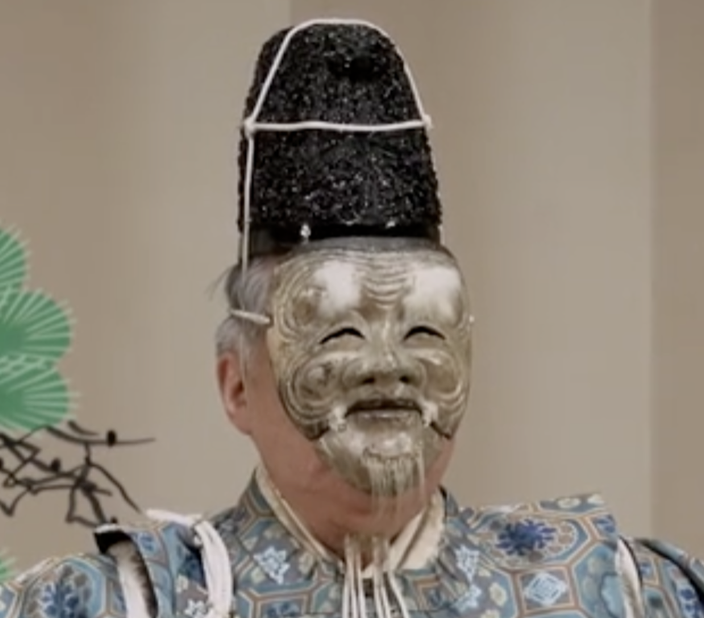
The mask has a white complexion, deep wrinkles on the forehead and cheeks, and a broad smile. Its most characteristic features are the crescent-shaped eyes, which suggest laughter, and the round, bushy eyebrows, usually made of hemp or animal hair. The mustache is painted, while the beard is made of implanted horse hair. Some examples have a few visible teeth, while others have none. A black line running along the upper edge of the mask corresponds to the position of the black lacquered hat worn by the performer. The stylized wrinkles, squint eyes, and joyful expression give the mask an abstract, almost otherworldly appearance. Unlike most noh masks, which retain certain naturalistic features, Hakushiki-jō is one of the most abstract types. This reflects its ancient origins and its special ritual function.
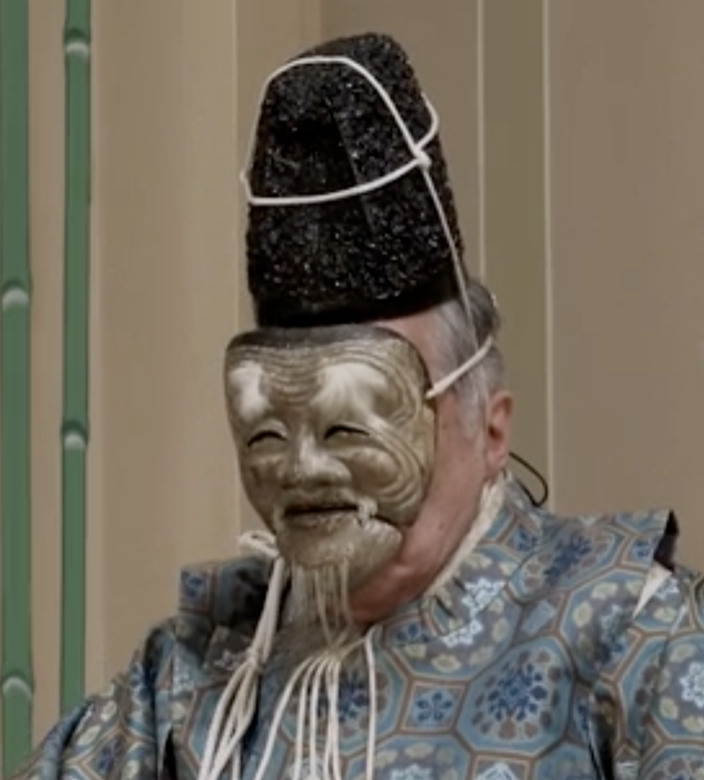
The mask used in the performance documented in this website is attributed to the mask carver Miroku (弥勒) and dates to the Muromachi period (1336–1573). It is one of the most treasured masks in the Kongō collection. Relatively large, both wider and taller than other examples of Hakushiki-jō, it is frequently worn by the Kongō iemoto (head of the school) in ceremonial performances of Okina, particularly those held at shrines.
Sanbasō Mask: ‘Kokushiki-jō’
Kokushiki-jō (黒式尉), meaning ‘black venerable old man’, represents the face of Sanbasō, a rustic deity associated with agricultural fertility and prosperity. The role is performed by a kyōgen actor, and the mask is used exclusively in the Okina ritual.
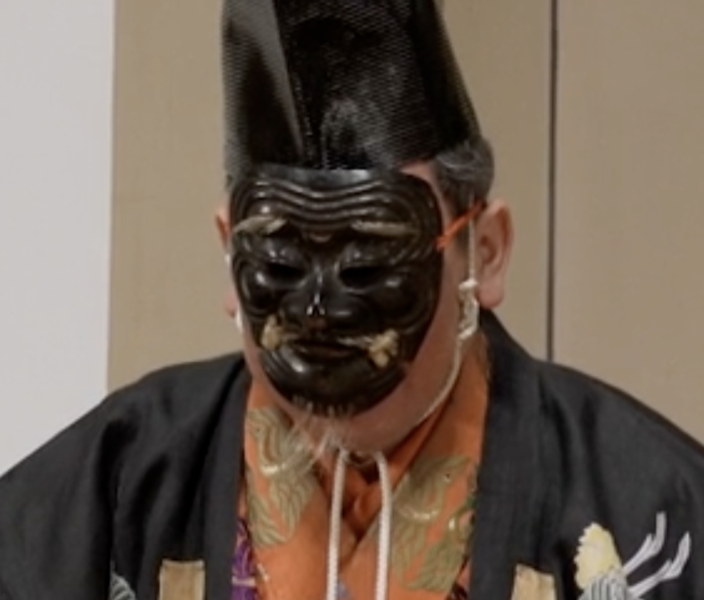
Like Hakushiki-jō, this mask has deep wrinkles on the forehead and cheeks, crescent-shaped eyes suggesting laughter, a painted mustache, and a detached lower jaw (kiriago). However, its dark complexion and more rugged features distinguish it from the refined white mask of Okina. The eyebrows are usually made of implanted hair, and the beard may also feature hair inserts. The mouth is broadly smiling, sometimes revealing a few teeth. A black line at the top of the forehead marks the position of the lacquered hat worn in performance.
Kyōgen Interlude Mask: ‘Enmei Kaja’
Enmei Kaja (延命冠者), meaning ‘life-prolonging young man’, represents the smiling face of a young man associated with longevity and prosperity. It belongs to the ancient group of masks connected with the Okina tradition, predating the development of noh in its present form. However, unlike the masks of Okina and Sanbasō, Enmei Kaja does not have a detached lower jaw. In the performance featured on this website, it is used by a kyōgen actor in the special interlude Pine and Bamboo Furyū (Shōchiku no furyū).
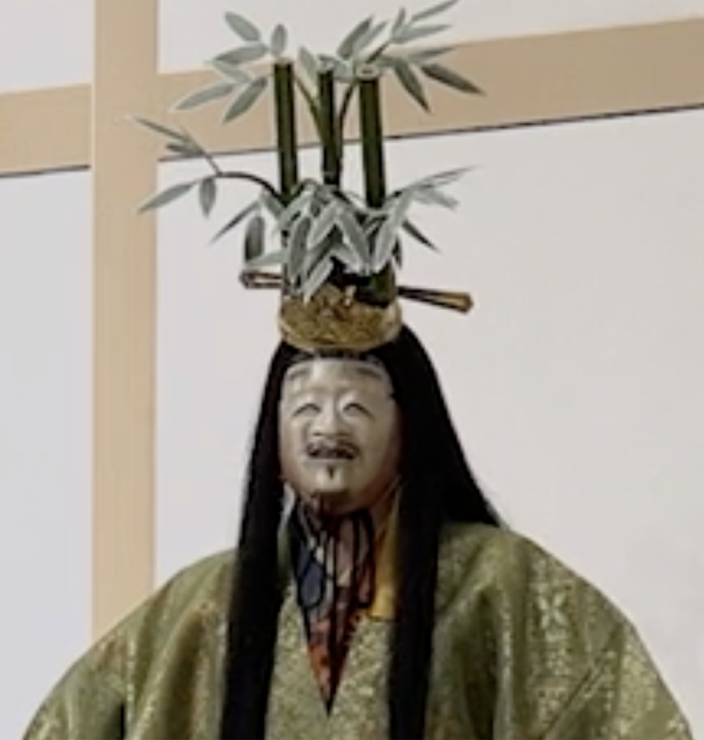
Its most distinctive features are the crescent-shaped eyes, which give the impression of laughter, and the smooth forehead and cheeks, almost entirely devoid of wrinkles. Some examples of this mask-type feature dimples, emphasizing the character’s youthful and cheerful appearance. The mask may have a lightly painted mustache and a small implanted beard. A black line across the upper forehead indicates the position of the lacquered hat worn by the performer.
The mask’s relatively simple design, particularly the absence of detailed facial modeling, gives it a stylized and somewhat abstract appearance. Rather than portraying an individual young man, it represents an idealized figure associated with the blessings of youth and long life.
Kyōgen Interlude Mask: ‘Noborihige’
The Noborihige mask, introduced above in connection with Kokaji, is also used in the special kyōgen interlude Pine and Bamboo Furyū (Shōchiku no furyū). In this context, it represents one of the spirits of the pine and bamboo, participating in the auspicious celebration associated with the Okina ritual. Although Noborihige does not belong to the ancient group of masks specific to Okina, its smiling expression, crescent-shaped eyes, and exaggerated wrinkles create a visual affinity with the masks of Okina and Sanbasō. Its cheerful, rustic appearance is particularly appropriate for the festive and celebratory character of the interlude.