Stage
Introduction
The Noh stage is unique in its shape and components. First of all, it has a single entrance and exit for the actors, designated by a multicolored curtain on the back-right side (directions are given in relation to an imaginary actor standing in center stage, facing the audience in front). The entrance opens up to a bridge lined with three pine trees that leads to the stage. This is the main space and is square in shape.
A pine tree adorns the back wall and an extended space in the back and left side of the stage accommodate the musicians, while the jiutai’s members kneel in a space on the stage's left. The stage has four pillars and is covered by a roof that extends over the bridge. There is a small sliding door on the back-left corner of the stage that the stage attendants and jiutai members use to enter and leave the stage. Finally, the audience sits in a semi-circle from the right side to the front of the stage.
The painted pine tree on the back wall of the stage reminds us of the outdoor origins of Noh. It is also a symbol of the famous Yōgō Pine at the Kasuga Shrine in Nara where Noh has been performed since its beginnings.
The roof above the stage also testifies to the origins of Noh, which only moved indoors in 1882. Moreover, it references spaces of shinto rituals and the sacred architecture of shrines. It is supported by four named pillars. The right backstage pillar is referred to as the shite-pillar (shite-bashira) as it is the closest to the position he occupies when engaged in an extensive conversation with the waki. The right front stage pillar is called the viewing-pillar (metsuke-bashira), and it is placed at the crossing point of all seating. These two pillars are particularly important in helping a masked actor whose sight is thus limited, to have a sense of space when walking or dancing. The left front stage pillar is called the waki-pillar (waki-bashira), since this is where the waki sits when he is not actively participating in the action. Finally, the left backstage pillar is referred to as the flute-pillar (fue-bashira), as this is where the nohkan player sits.
The square-shaped stage is divided into a 3 x 3 grid, with nine named sub-squares. We have adopted the numbering method from 1 to 9 that Monica Bethe and Karen Brazell established, and used it when referring to specific sub-squares.
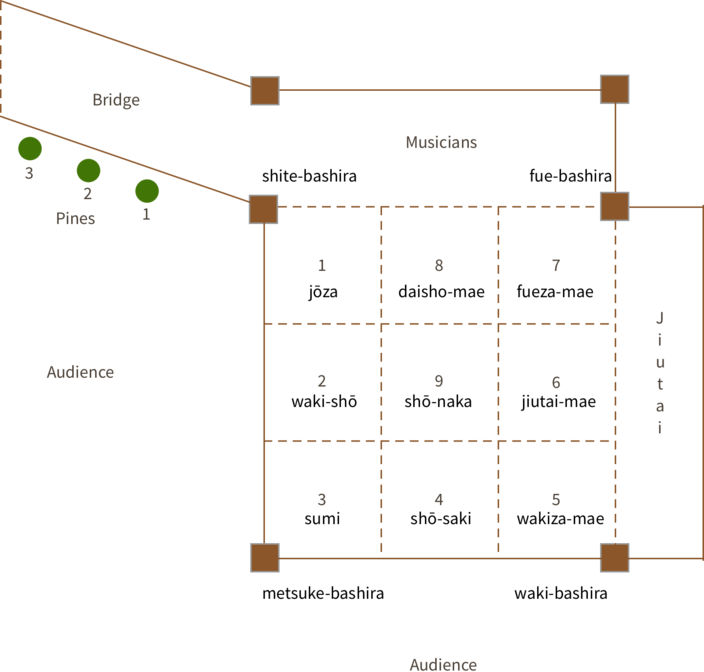
The sub-squares do not share the same dramatic potential since a dance movement is more powerful or subdued depending on where it is performed. Squares 3, 4, and 9 are the strongest positions, Square 3 because it is in plain sight to all viewers, Square 4 because it is center-front stage, and Square 9 because it is center stage. Squares 1 and 8 are used as starting and/or closing location for a dance or dance segment. Square 5 is usually occupied by the waki, who sits at that position once he has completed his entrance. Square 7 is rarely used being close to the nohkan player's kneeling position. Squares 2 and 6 are often used as intermediate positions when a dancer is moving from back to front-stage or vice versa. There are also conventions associated with the stage. For instance, in the Kanze and Kongō schools, front-stage represents South, as shown in the Figure below. For the other three schools, front-stage represents North:
| Orientation | Cardinal Point |
| Stage Right | West |
| Front | South |
| Stage Left | East |
| Back | North |
Under some Noh stages, large empty clay jars amplify the sound of the shite’s stamping, as well as the sound of the drums, flute, and voices from the jiutai.
Another unique feature of the Noh stage is the upstage-right narrow bridge used by actors to access the stage proper. Although it is also used as a performing space, in the tradition of mugen Noh the bridge can be interpreted as a link between two separate realities, the everyday world and the otherworldly apparitions of ghosts and spirits. It functions as a liminal space between the waki's real world and the shite's other world. It is flanked by three pine trees used to divide the bridge into three parts. They are numbered from 1 to 3, where Pine 1 is closer to the stage, and Pine 3 closer to the multicolored curtain.
Its colors are related to the five elements: wood, fire, earth, metal, and water, respectively associated with the colors: green, red, yellow, white, and black, the latter being replaced with violet in the curtain’s five colors. The curtain’s colors from left to right can either be violet, white, red, yellow, and green, or the other way around. The colors of the curtain in the Kongō Theater follow the former sequence.
Kokaji
The simplicity of the Noh stage allows for various reinterpretations of its space. For instance, the stage represents three different locations for the entrance of the three characters in Kokaji’s first act. The first one to appear is the wakizure, an imperial envoy. Thus, the bridge and stage represent the palace where he works. The second character to enter is the waki, Munechika the swordsmith, and at that moment, the bridge represents his house or factory. Finally, when the shite appears, the bridge, as well as the stage, represent somewhere outside of Munechika’s house. In Kokaji’s second act, the addition of a prop helps identify a specific location, since the dais on Square 4 represents Munechika’s forge.
Hashitomi
In Hashitomi, the first character to walk on stage is the waki, a monk living in Unrin-in Temple in northern Kyoto. Thus, the bridge and stage are understood to represent that temple. Things are a little less obvious, though, with the entrance of the shite, a character who might be seen as a flower or as the ghost of a woman. As the monk is about to celebrate a mass for the flowers, he notices an unusual white one among his lot, and as he wonders about it, the shite, appearing as a woman, speaks for the flower. Some say that she is the flower’s voice, others say that she is physically present and embodied by the shite. The choreography adopted by the Kongō school appears to support the former interpretation. The distance between the two characters involved in a dialogue, the waki kneeling at Square 5 and the shite standing on the Bridge at the Second Pine, may suggest that the waki can hear but not see her. In Hashitomi’s second act, like in Kokaji’s, a prop is brought in. It helps identify a specific location, since the prop standing on Square 8 represents the woman’s dwelling.
Takasago
In this celebratory production, the waki enters at Square 9 in order to deliver a special blessing, known as kaikō, from this most central position on the stage. He then identifies himself as a Shinto priest from Aso in Kyushu. Standing facing the two wakizure, he sings of their journey towards the capital. In the latter part of this song, the waki’s steps at Square 5 evoke the progress of their journey. When the song ends, the stage becomes the shore of Takasago, where they have arrived.
The entrances of the old woman and old man make particularly dramatic use of the bridge. The woman enters first, followed at a distance by the man; they stop at Pine 1 and Pine 3, respectively, before turning towards one another. Their communion across this distance evokes a central idea of the play: that distance does not diminish love. In the pine grove of Takasago, they gather pine needles while speaking of the virtues of waka poetry and of pine trees. Throughout the first act, the stage represents the pine grove of Takasago. At the end of the act, the shite, having sat at Square 9 and hinted at his divine identity, rises and advances to Square 4. There, he mimes boarding a boat and uses his costume as its sail as he sets out for Sumiyoshi. As he walks from Square 4 to Square 1, the stage becomes the sea across which he travels.
In the second act, the waki and wakizure again stand facing each other on stage and sing of their journey. Once the song has ended, the stage becomes the pine grove of Sumiyoshi. The nochi-shite, the deity of Sumiyoshi, then appears. Throughout the second act, the stage represents either the pine grove of Sumiyoshi or a fictional space in which the deity dances and revels.
Okina
Unlike other Noh plays, Okina is often understood as recreating within the theater a ritual space in which deities manifest themselves. It opens with a solemn procession across the bridge: Senzai leads, carrying the Okina mask in its box, followed by the elderly performer who will become Okina. Senzai presents the box to the audience as he carries it to the prominent Square 3.
Okina sits at Square 7 and puts on his mask there. The arrangement of Okina at Square 7, Senzai at Square 5, and Sanbasō at Square 1 gives each character a distinct spatial presence. Okina occupies the dominant position between the other two, at the only true corner of the stage; Sanbasō holds the prominent entrance position at Square 1; and the young Senzai, at Square 5 near the audience, appears more vulnerable. Okina then performs a formal solo ritual, witnessed by the musicians, who initially line the bridge.
The bridge is often used in Okina by groups of performers, creating a sense of public ritual with witnesses and participants. After the musicians move from the bridge to their usual position at the back of the stage, the jiutai takes its place behind them. This arrangement recalls an older practice: by the seventeenth century, the jiutai had come to sit at stage left, whereas in Okina it is seated as it was in earlier times. In this especially festive production, which includes a Furyū middle section, the bridge is subsequently lined with Kyōgen actors.
Okina performs the prayer section at Square 8 and uses the entire stage for the dance section. Even after removing his mask, he remains in performance, accompanied by the mysterious sound of the kotsuzumi, as he proceeds along the bridge towards the curtain. The Furyū section, performed by Kyōgen actors, is framed as an unexpected intrusion into the otherwise continuous progression from Okina to Sanbasō. Furyū Senzai delivers his opening at Square 1, a typical position for Kyōgen actors. The Spirits of Pine and Bamboo first stop on the bridge for their introductions, then move to Squares 2 and 6, respectively, while Furyū Senzai takes Square 8. This large, symmetrical triangle fills the stage and gives balance and power to the blessing dance that follows.
The two spirits dance in simlar balance through synchrony, performing the same kata on opposite sides of the stage. Sanbasō’s final act, including his dances, uses the entire stage, leaving no corner of its ritual world unseen. Like Okina, he removes his mask on stage, at Square 7. His subsequent exit, however, is not accompanied by drums and is not considered part of the theatrical performance.